
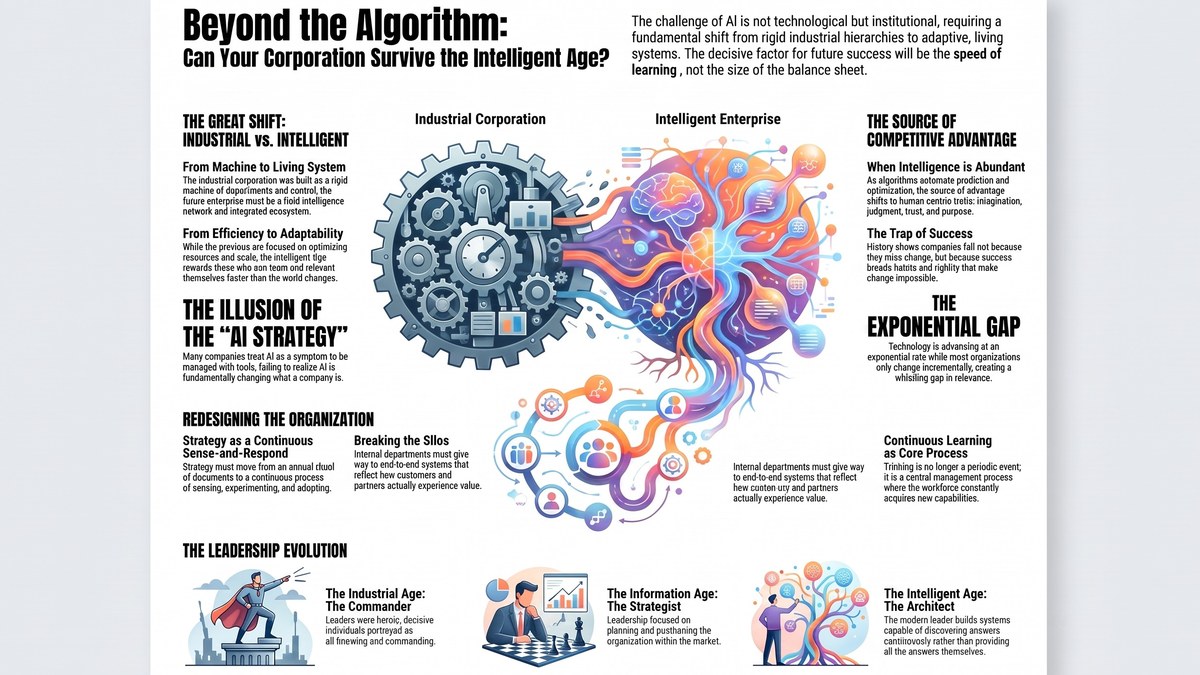
Beyond the Algorithm: Can Your Corporation Survive the Intelligent Age?
The Industrial Model Runs Out of Oxygen The challenge artificial intelligence creates for companies is not technological; it is institutional. The issue is not simply buying more AI tools, but redesigning the organization itself: moving from the rigid hierarchy inherited from the industrial era to a living system capable of learning and adapting faster than the environment around it.
The traditional corporation was built like a machine: rigid hierarchies, isolated departments, annual planning cycles, strict control systems, and an obsession with efficiency and scale. This design worked well in a world of slow information and stable markets, where competitive advantage came from optimizing known processes.
That world no longer exists. AI is moving beyond isolated experimentation and beginning to reshape how companies are managed, including decision-making structures and middle-management roles.
From Machine to Living System The shift toward the Intelligent Age involves four simultaneous transformations: from machines to living systems, from hierarchies to intelligence networks, from silos to integrated ecosystems, and from fixed organizational boundaries to fluid ones.
This transition moves organizations from isolated AI use cases to connected systems in which customer experience, operations, research and development, strategy, and talent reinforce one another through a continuous cycle of sensing, deciding, and adjusting.
Organizational structures are likely to become more compact and horizontal because AI can automate basic reporting, analysis, coordination, and other administrative tasks. Hierarchies designed for purely human workflows may gradually give way to AI-first networks in which people and intelligent agents coordinate and execute work in real time.
Where Advantage Lies When Intelligence Is Abundant If algorithms increasingly automate production and optimization, where does competitive advantage remain? Advantage shifts toward genuinely human capabilities: imagination, judgment, trust, purpose, and, above all, the ability to learn faster than the surrounding environment changes.
This connects with the success trap: companies do not fail because they cannot see change coming, but because their success creates habits and rigidities that make change difficult. While technology advances exponentially, most organizations change incrementally, creating a widening relevance gap.
As a result, the speed of learning—not the size of the balance sheet—becomes a decisive factor in long-term survival.
Redesigning the Organization from Within Turning this transformation into reality requires concrete institutional changes, not merely an innovation narrative:
Continuous learning as a management process: training becomes a central operating process through which employees continuously acquire new capabilities.
Strategy as continuous sensing and experimentation: the annual strategic plan gives way to an ongoing cycle of detecting signals, experimenting, and adopting.
Human–AI collaboration: work is organized around hybrid teams of people and AI agents rather than departments separated by function.
End-to-end value systems: internal silos give way to integrated systems that reflect how customers and partners actually experience delivered value.
Executives should therefore redesign roles, decision rights, skills, and responsibilities instead of simply automating existing processes.
The Evolution of Leadership: From Commander to Architect In the industrial era, the leader was a commander: a heroic and decisive figure who monitored and directed the organization from above. In the information era, the leader became a strategist focused on planning and positioning the organization in the market.
In the Intelligent Age, the role evolves into that of a learning architect—someone who builds systems capable of continuously discovering answers rather than personally providing every answer.
The challenge is no longer whether to adopt AI, but whether it can be integrated coherently, governed responsibly, and scaled across decision-making, risk management, and value delivery. Senior executives must move from strategy to system, defining which decisions can be automated and which require human oversight.
The leader moves from making every decision to designing the system that makes decisions: becoming an architect of decision-making.
The Board as Guardian of Future Relevance Boards are moving beyond compliance oversight to become guardians of the company’s future relevance, with particular responsibility for monitoring the organization’s speed of learning.
They must govern AI as a business transformation rather than a technology project, decide where the company should lead or follow, guide the required talent and culture, oversee the transition toward a mixed workforce of people and AI agents, supervise risks and controls, and monitor real-world outcomes.
This oversight is a fiduciary responsibility. Directors do not need to program models, but they do need to verify that management is handling AI competently and honestly, and that warning signals reach the board in time for action.
Conclusion Corporate survival in the Intelligent Age will not depend on how much AI a company buys. It will depend on how quickly the entire organization—from the boardroom to the front line—can learn, adapt, experiment, and turn intelligence into meaningful value.